
Keys to communicating and making connections
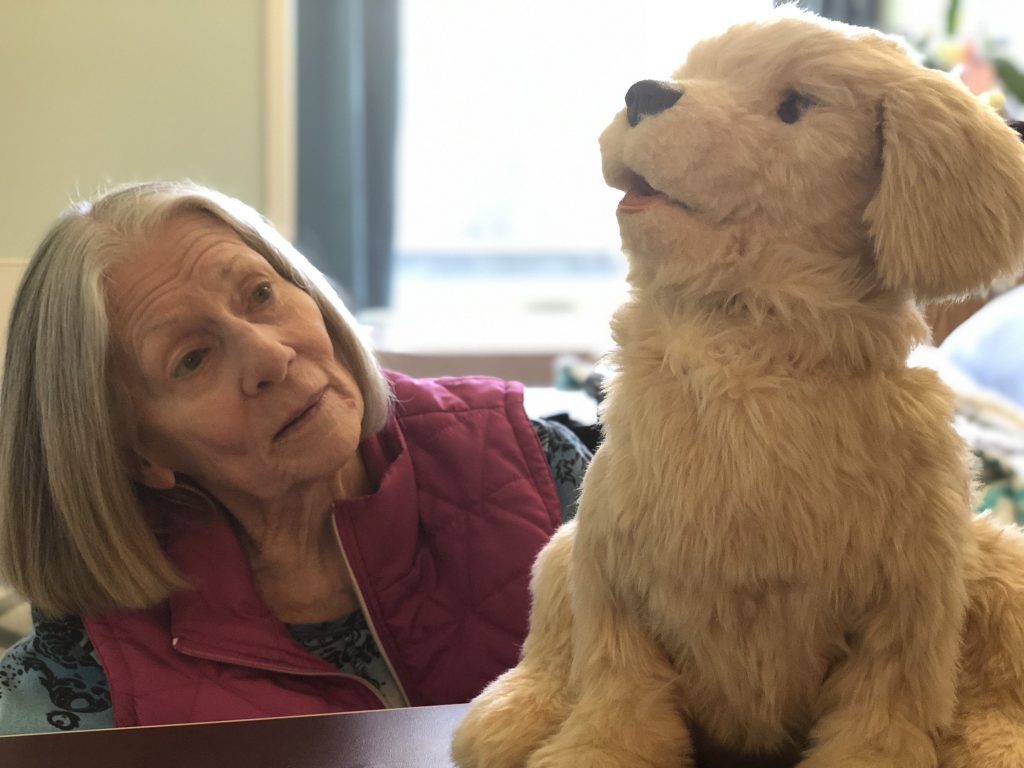
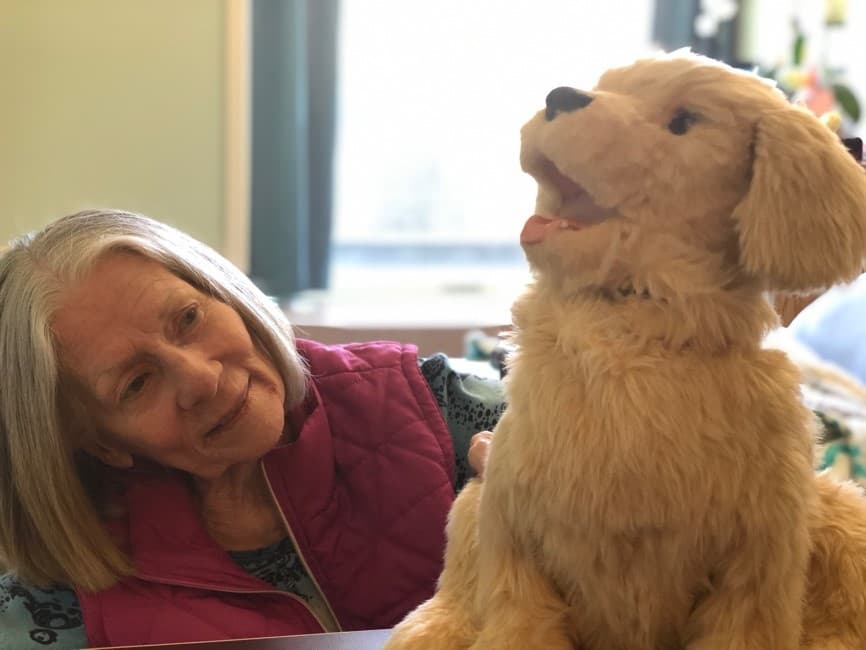
I captured this photo of a client last week during a visit with her in long-term care. She absolutely loves her interactive pup (see link near the end of blog). And with some additional cueing and support, it provides us with a wonderful and meaningful way to share a connection with a mutual love – dogs!
I hesitate to describe our client as someone living with dementia. It’s true, she is. But such a label, whether we are consciously aware of it or not, can create a social, emotional and physical distance between us and the person for whom we are caring. This gap might limit our interactions because of our own biases or fears around aging and disease. Unfortunately, it can also result in lost opportunities to engage, connect and have meaningful moments with our frail elders.
When visiting with all our clients, our hope is to connect with them wherever they are at, in that moment, on that day. Being together, sharing moments and telling stories is at the heart of relationships. It’s understandable and normal for families to feel uncertain or uncomfortable in how to be with their loved one when the usual connections have changed or been altered in some way.
The key message I want family caregivers to take away from this blog is this: Communication is still possible – it just looks different. Following are some suggestions that may help to make your next visits more comfortable and connected.
How to approach communicating with seniors facing challenges
When an individual is faced with an impairment or challenge – be it visual, speech, auditory or cognitive – it requires us to approach communication with an appropriate attitude. This list of tips about communication is from the Alzheimer Society of Canada but is applicable to other impairments. In fact, most of the tips are simply good advice for communicating with anyone, whether it’s your child, spouse, co-worker or parent!
- Believe that every person, regardless of their age or ability, maintains a core self that can be reached.
- Be creative in expressing feelings and messages.
- Understand the effects of disease on communication.
- Practice patience by slowing down, listening, watching, waiting for responses and repeating a phrase using similar or slightly different words.
- Strive toward perfection by being precise in how you convey your messages and feelings.
- Remember that respect and validation are central to every visit.
Key visiting points to keep in mind
- Visiting in its most basic sense means being “present.” Check in with yourself at the door before visiting with an aging loved one. How are you feeling? Our anxiety, frustration and tension are easily communicated with our body and language.
- Maintaining our identity – our sense of competence – is central to us all. This attribute continues as we age.
- Emotional memory persists for those with cognitive loss; feelings are often stronger, more expressive and direct.
- Ties of affection are affirmed by spending time with our loved ones.
- Change your expectations of visits as your relative’s functioning undergoes changes.
- Acknowledge your relative’s feelings and emotional state. Empathize and then move ahead in a respectful manner.
- As language skills diminish for people with cognitive loss, place less emphasis on expecting answers to questions. Often, the capacity to understand is greater than the ability to be able to verbally express how they are feeling. You can avoid or minimize frustration and feelings of inadequacy when removing the expectation to “perform.” Turn questions into statements about the here and now. For example, “It’s good to see you today” or “I like your shirt.” Provide your relative with information such as, “Today is Friday, the day you attend the Adult Day program.”
- Who doesn’t like a sincere compliment? They’re usually welcome and help create a comfortable mood.
- Providing links and visual cues with past things they have enjoyed can help shape your visits.
- Activities can help generate pleasurable feelings. For example, try brushing their hair or massaging their hands with cream. Give a gentle shoulder massage. Listening to music, browsing a magazine, sitting at a window or going with them to a program are all activities that provide pleasure and stimulation without the need to make conversation.
A few other ideas for visits with elders
Bring props. We rarely come emptyhanded to our visits. Be it a funny video or pictures, a list of conversation starters or flowers, we like to have a few things to provide meaningful and customized interactions. (Maybe even try an interactive puppy, and bring along a little brush and bandana for it!)
Create a movie. Nowadays, user-friendly programs that allow you to make slideshows or movies accompanied by music abound. With some time upfront, a little skill and patience in editing pictures, you can create something that can be played over and over again. And what a lovely gift to yourself, too!
Create a playlist. We have a dedicated playlist for our clients based on their preferences. Sometimes we even try a little “Name that Tune.”
Read short stories. We all love to hear a good tale.
Download conversation starters. Heck, you can even use these at your next post-pandemic dinner party!
Bring a toolbox of things to decorate. I have a client who has decorated her mom’s room with owls (her favourite), strings pictures up, adds colourful landscape pictures and so on. Her decorating essentials include: sticky back hangers for lightweight pictures or to hold up a string of greeting cards; scissors; tape; a sewing kit; markers; small pliers (to fix earrings, wires, etc.); push pins.
Get out for a drive. Since the pandemic, so many seniors haven’t been outside.
Go outside. Plant some flowers or simply enjoy the sunshine.
Defining a “successful” visit
Success is sharing an experience with the person you are caring for. Letting them know they are not alone is an accomplishment. Enjoying an activity that gives them meaning and purpose is a win.
A good visit is about enjoying the “moments of reality” they experience. Success is seeing them smile and knowing that your visit is leaving them with a good feeling. And hopefully you feel it, too.
We wish you all the best with your next visit.